 Academics
27 Ways We Teach. One Reason We Do It.
At American World School Chennai, we have never accepted the idea that one method of teaching works for every student. The lecture that lights up one child leaves another cold. The project that unlocks a student’s potential might be the same thing that frustrates their classmate. Real learning — the kind that stays, the kind that transfers, the kind that actually prepares a young person for life — requires more than a single approach delivered uniformly to a room full of individuals.
That is why we have built something different.
As Asia’s first entrepreneurial school, AWS integrates 27 carefully designed learning methodologies into a dynamic, personalised educational ecosystem. These are not gimmicks or trends. Each one is grounded in research, shaped by our educators, and chosen because it develops the specific skills, dispositions, and capabilities that the world genuinely needs from the next generation — creativity, critical thinking, collaboration, resilience, and the courage to build something new.
Together, these 27 methodologies do not compete with one another. They complement, reinforce, and deepen each other — creating a learning experience that is as rich and multidimensional as the students who move through it.
Every single approach we use at AWS — regardless of subject, grade level, or learning mode — is designed to move students toward the same four outcomes:
Discover their unique strengths and passions.
Engage with real-world challenges that demand genuine thinking.
Develop the future-ready competencies that universities and careers require.
Lead with innovative, ethical, and practical solutions.
These are not aspirational statements on a wall. They are the design brief behind every lesson, every project, and every learning experience a Falcon encounters from Kindergarten to Grade 12.
Learning Through Local and Global Connections
Students engage in projects rooted in their community, culture, and environment — using the real world as the foundation for everything they study. By exploring local heritage, landscapes, and societal challenges, learners develop a deep connection to their surroundings while applying knowledge across subjects in ways that feel meaningful and alive.
Strengthens cultural awareness and civic responsibility. Encourages interdisciplinary thinking. Fosters environmental and social stewardship.
Reflection and Application in Real-World Contexts
Students participate in immersive experiences — field trips, simulations, hands-on activities — and then reflect, analyse, and apply what they have discovered. This process connects new knowledge to lived understanding, building the kind of learning that stays long after the experience ends.
Enhances critical thinking and self-awareness. Builds problem-solving and adaptability. Encourages lifelong learning habits.
Collaborative Knowledge Sharing
Learning happens through interaction, discussion, and teamwork. Students exchange ideas, mentor one another, and engage in collaborative problem-solving — creating a classroom culture where every voice contributes and every perspective matters.
Develops communication and leadership skills. Promotes diverse perspectives and empathy. Strengthens community and collaboration.
Real-World Problem Solving Through Extended Projects
Students work on complex, open-ended challenges that require sustained research, creativity, and interdisciplinary thinking. Project-Based Learning places students in the driver’s seat — designing, executing, and presenting solutions to problems that do not have a single right answer.
Builds research, planning, and execution skills. Encourages innovation and creative confidence. Prepares students for academic and professional challenges.
Solving Global and Local Problems
Students identify real-world issues, investigate their root causes, and develop actionable solutions — blending STEAM with entrepreneurship to create impact-driven learning. This methodology teaches students not just to understand a problem, but to do something about it.
Strengthens critical and systems thinking. Encourages social responsibility and leadership. Develops practical problem-solving capabilities.
Learning Through Exploration and Creativity
Students engage in structured and unstructured play that stimulates cognitive, social, and emotional development. This approach honours the natural way children learn — through curiosity, experimentation, and joyful discovery — while building foundational concepts across every subject area.
Develops problem-solving and healthy risk-taking. Enhances social skills and emotional intelligence. Builds academic concepts through hands-on experience.
Connecting Education to the Natural World
Learning extends beyond classroom walls as students explore ecology, sustainability, and environmental science through direct interaction with nature. The world outside becomes as rich a classroom as any room inside the building.
Improves focus and mental wellbeing. Teaches environmental responsibility. Strengthens observation and analytical skills.
Creating Solutions for a Better Future
Students examine global sustainability challenges and design innovative solutions that balance ecological, economic, and social considerations. This methodology integrates systems thinking and ethical decision-making into every subject it touches.
Develops global citizenship awareness. Encourages innovative and practical problem-solving. Prepares students for careers in the green economy.
Investigating Real-World Events and Patterns
Students explore complex, real-world phenomena — climate change, technological disruption, economic inequality — through interdisciplinary lenses, deliberately breaking down the artificial barriers between traditional subjects.
Builds holistic understanding of interconnected systems. Enhances research and analytical skills. Encourages big-picture thinking.
Mastering Skills Through Playful Challenges
Students engage with educational games — digital and physical — that teach curriculum concepts while developing strategy, collaboration, and perseverance. Learning through well-designed challenge is one of the most effective ways to build deep understanding.
Increases engagement and motivation. Develops computational and logical thinking. Provides immediate feedback and adaptive challenge.
Combining Academics With Community Impact
Students identify local needs, develop service projects, and reflect on their experiences — connecting classroom learning to real-world social impact in ways that build both competence and character.
Strengthens civic engagement and empathy. Develops project management and leadership skills. Creates tangible benefits for real communities.
Solving Problems Through Innovative Business Models
Students learn to develop financially sustainable solutions to social challenges — blending business acumen with genuine social impact. This methodology sits at the very heart of what it means to be Asia’s first entrepreneurial school.
Teaches resourcefulness and ethical leadership. Develops business and financial literacy. Encourages creative problem-solving for social good.
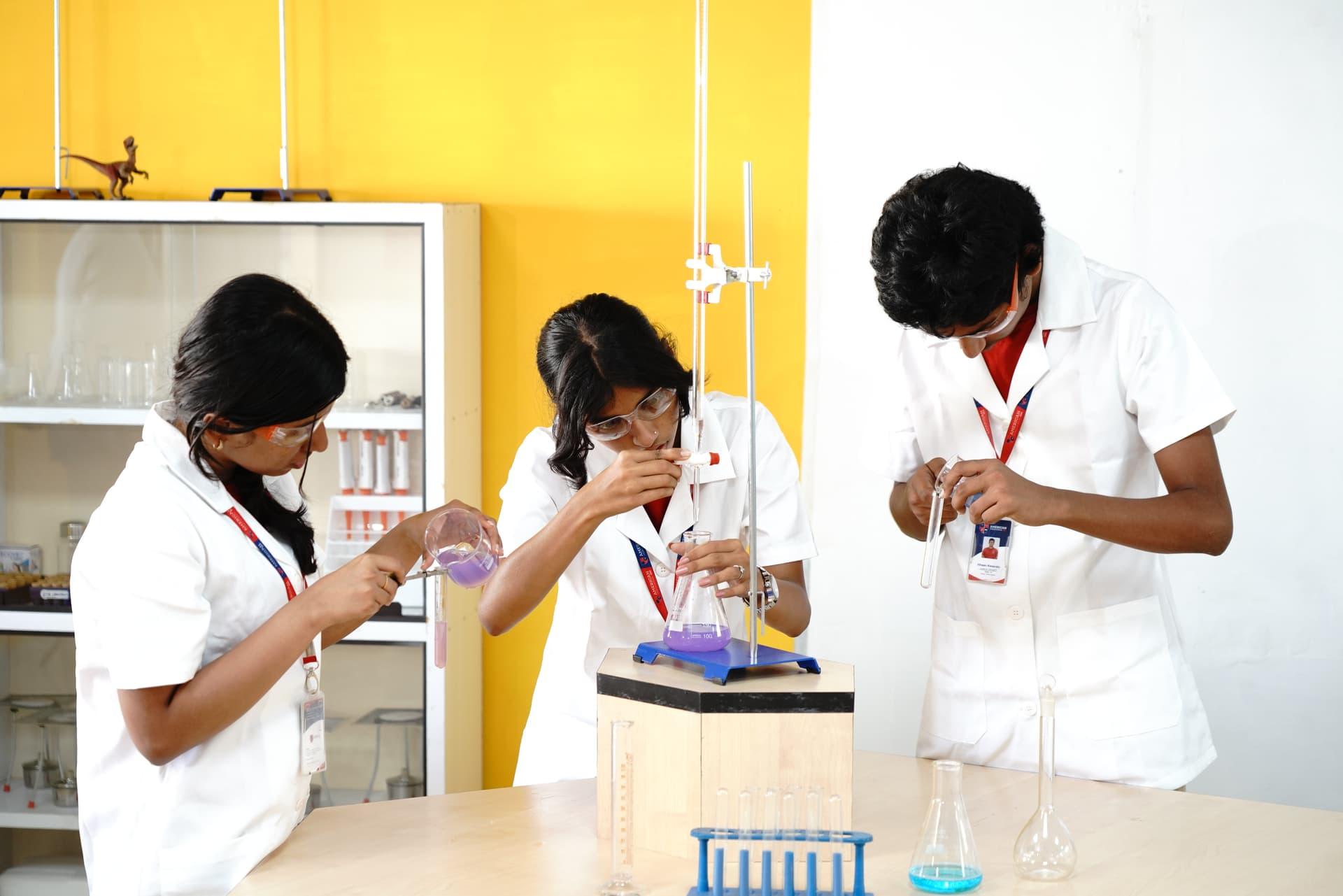
Hands-On Innovation in Our Makerspaces
Students experiment with tools, technology, and materials to design, prototype, and refine solutions in collaborative workshop environments. The Makerspace is where ideas stop being ideas and start becoming things.
Develops engineering and design thinking skills. Encourages trial-and-error resilience. Fosters creativity and technical proficiency.
Expanding Minds Through Language
Students develop proficiency in multiple languages, enhancing cognitive flexibility and cross-cultural communication. In a school community as internationally diverse as AWS, multilingual learning is not just an academic advantage — it is a daily reality.
Improves memory and executive functioning. Prepares students for global careers and relationships. Deepens cultural understanding and empathy.
Bridging Classroom Knowledge With Practical Experience
Students engage in real-world simulations, case studies, and industry partnerships that mirror professional environments. Academic concepts are not just learned — they are tested against reality.
Develops job-ready skills and a professional mindset. Enhances decision-making under real-world constraints. Builds confidence in transferring theory to practice.
Learning Driven by Student Interests
Students design and pursue long-term investigations into topics of personal passion — developing genuine expertise through independent research and creative expression. At AWS, what a student loves is never a distraction from their education. It is the engine of it.
Cultivates intrinsic motivation and ownership of learning. Develops expertise in areas of genuine interest. Teaches project planning and self-management.
Mastery Through Sustained, Rigorous Inquiry
Students engage in intensive, extended exploration of complex topics — developing nuanced understanding through primary research, expert conversations, and multidisciplinary connections. This is learning that goes all the way down.
Builds subject-matter expertise. Develops advanced research and synthesis skills. Prepares students for university-level scholarship.
Human-Centred Problem Solving
Students master the five-phase design process — Empathise, Define, Ideate, Prototype, Test — to create innovative solutions for real human needs. Design Thinking teaches students to start with the person, not the product.
Develops user empathy and deep observation skills. Strengthens iterative thinking and resilience. Produces tangible, tested, real solutions.
Education Unbound by Location
Students leverage mobile devices and cloud platforms for learning anytime, anywhere — using augmented reality, micro-lessons, and digital collaboration tools to extend the classroom beyond any physical space.
Enables personalised pacing and accessibility. Prepares students for digital workplace norms. Facilitates genuine global classroom connections.
Growth Through Challenging Experiences
Students undertake physical, intellectual, and cultural adventures — expeditions, hackathons, cultural immersions — that push comfort zones and build the resilience, adaptability, and grit that no textbook can teach.
Develops grit and adaptability. Creates transformative learning moments. Builds teamwork in high-stakes environments.
Professional Immersion for Career Readiness
Students gain authentic workplace experience through structured internships with partner organisations — applying classroom knowledge in professional settings and building the networks, skills, and self-knowledge that prepare them for what comes after graduation.
Provides industry-specific skill development. Builds professional networks and references. Helps clarify career pathways with real evidence.
Rapid Skill Acquisition Through Intensity
Students engage in short-term, high-intensity learning sprints — coding bootcamps, design sprints, subject intensives — to master specific competencies through total immersion. The pressure is real. So is the growth.
Achieves rapid skill development. Builds focus, perseverance, and deadline management. Mirrors real-world professional intensity.
Iterative, Adaptive Skill Building
Students work in rapid cycles of planning, execution, and reflection — mirroring the methodologies of the world’s most innovative companies and organisations. At AWS, learning is never a one-shot exercise. It is a continuous loop of doing, reflecting, and improving.
Develops flexibility and responsiveness. Encourages a continuous improvement mindset. Prepares students for fast-evolving industries.
Scholarly Inquiry as Foundation
Students conduct original academic research using proper methodologies — from literature reviews to data collection, analysis, and peer presentation. This is learning that takes ideas seriously and holds them to account.
Develops academic rigour and intellectual curiosity. Teaches ethical research practices. Prepares students for university-level scholarly work.
Student-Led Agenda Setting
Students self-organise around shared interests — creating spontaneous working groups to explore topics and solve problems without predetermined structure. This methodology trusts students to know what matters to them and gives them the space to pursue it.
Develops initiative and self-direction. Encourages organic, interest-driven collaboration. Mirrors creative and entrepreneurial workplace dynamics.
Scaffolded Independence Development
Students progress through graduated levels of self-directed learning — from guided projects to fully independent scholarly work — at a pace calibrated to their individual readiness. Independence is not assumed. It is built, deliberately and carefully, over time.
Builds self-management skills progressively and sustainably. Allows personalised independence pacing. Prepares students for lifelong self-directed learning.
Innovation as a Mindset, Not a Subject
Students approach every subject through entrepreneurial lenses — blending Entrepreneurship with Science, Technology, Engineering, Arts, and Mathematics into a unified framework for creative, impact-driven thinking. This is the methodology that sits at the heart of everything AWS does.
At most schools, entrepreneurship is an elective. At AWS, it is the air. It shapes how we ask questions, how we frame problems, how we measure success, and how we prepare every Falcon to step into the world not just as a graduate, but as a builder.
Develops opportunity recognition and creative confidence. Teaches resource mobilisation and rapid prototyping. Prepares job creators — not just job seekers.
These 27 methodologies are not a menu that students choose from. They are an interconnected ecosystem — woven together across subjects, grade levels, and learning modes to create an education that is genuinely greater than the sum of its parts.
At AWS, a student might begin their morning with a Passion Project, move into a Design Thinking workshop, collaborate with peers in a Project-Based challenge, and end the day reflecting on what they built, what worked, and what they would do differently. Every day is different. Every day builds on the last. And every day moves every Falcon closer to the person they are becoming.
They graduate from American World School Chennai as:
Ready to navigate a world that will not sit still.
Who build things that make the world genuinely better.
Who understand that their actions have consequences beyond themselves.
Who have the skills, the confidence, and the character to create something from nothing.
These 27 methodologies are not a menu that students choose from. They are an interconnected ecosystem — woven together across subjects, grade levels, and learning modes to create an education that is genuinely greater than the sum of its parts. A student might use Passion Projects, Design Thinking, and Project-Based Learning all in the same day.
ESTEAM blends Entrepreneurship with Science, Technology, Engineering, Arts, and Mathematics into a unified framework for creative, impact-driven thinking. At AWS, entrepreneurship is not an elective — it is the air. It shapes how we ask questions, how we frame problems, how we measure success, and how we prepare every Falcon to step into the world not just as a graduate, but as a builder.
Discover our curriculum overview, learn about our Innovation and Impact Programme, and see how we apply these methodologies across grade levels.



 Discover Our Curriculum