 Academics
Real Problems. Real Thinking. Real Results.
There is a version of school where learning means listening, memorising, and repeating. Where success means scoring well on a test that measures how much of someone else’s knowledge you have retained. Where the goal is the grade, not the understanding behind it.
American World School Chennai is not that school.
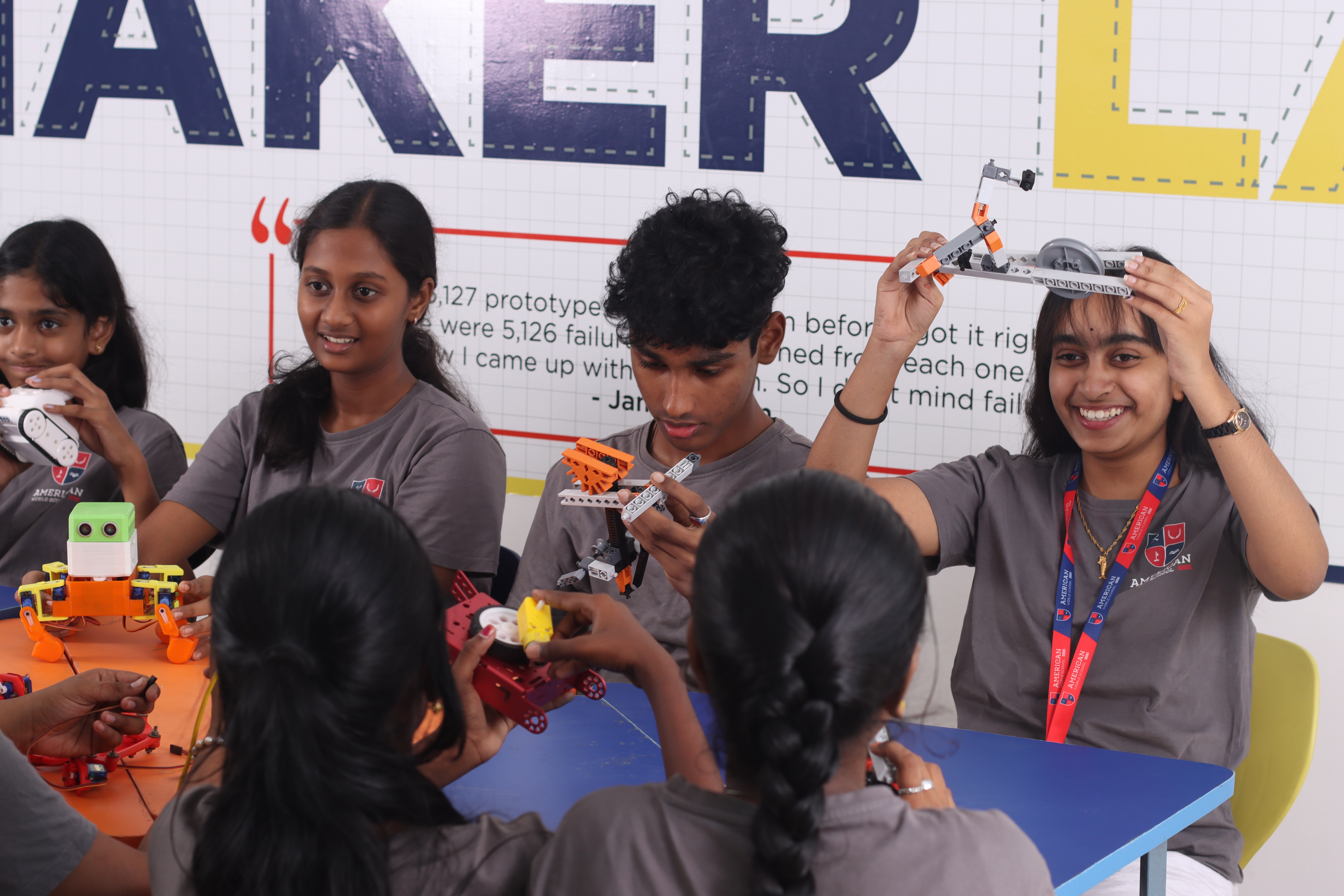
At AWS, learning is something students do — actively, collaboratively, and with genuine purpose. Project-Based Learning sits at the heart of everything we teach, at every grade level, across every subject — because we believe that the deepest, most lasting learning happens when students are given a real problem, the freedom to investigate it seriously, and the expectation that they will produce something that matters.
This is not learning by listening. This is learning by doing — and then presenting, defending, refining, and doing again.
Project-Based Learning — PBL — is a teaching methodology in which students work on complex, extended, open-ended challenges that require sustained thinking, research, collaboration, and creativity. Unlike traditional assignments that have a single correct answer, PBL challenges are designed around real-world problems that demand genuine inquiry and original responses.
At AWS, PBL is not a special event or an occasional enrichment activity. It is the primary mode through which students engage with their curriculum — woven into every subject, every term, and every grade level from Kindergarten through to Grade 12.
Every project at AWS is built around three questions that matter far more than any test:
What is the problem worth solving?
How will you investigate it?
What will you create, propose, or build in response?
The world our students are graduating into does not reward memorisation. It rewards the ability to identify a problem no one has fully solved, assemble a team, think across disciplines, manage complexity, communicate compellingly, and deliver something real.
These are not skills that develop from textbooks and tests. They develop from practice — repeated, structured, challenging, and supported practice. That is exactly what PBL provides.
Research consistently shows that students who learn through well-designed project-based approaches develop stronger critical thinking, deeper subject knowledge, greater confidence as communicators, and a more robust ability to transfer learning to new contexts. They are not just better students. They become better thinkers — and ultimately, better builders of whatever they choose to create in the world.
At AWS — Asia’s first entrepreneurial school — this is not an aspiration. It is a design principle.
Every PBL unit at AWS is anchored by a Driving Question — an open-ended, challenging, real-world prompt that focuses and sustains student inquiry throughout the project. A good Driving Question does not have one right answer. It has many possible responses, each requiring thought, evidence, and creative judgement.
Examples of the kinds of Driving Questions AWS students engage with:
These are not hypothetical exercises. They are genuine inquiries that students pursue with real rigour — and from which they produce real, presentable work.
Every project begins with a launch experience designed to spark curiosity and surface questions. Students encounter the Driving Question for the first time, explore what they already know, identify what they need to find out, and begin mapping the territory of their investigation. This is where the genuine questions start — and where student ownership of the learning begins.
Students investigate their Driving Question through rigorous, multi-source research. They gather evidence, conduct interviews, analyse data, examine case studies, and consult experts — building the knowledge base they will need to develop a credible, substantive response. AWS teachers guide this process, but students drive it.
Most AWS projects are collaborative — students work in teams, bringing different strengths, perspectives, and ideas to a shared challenge. This phase involves synthesis, debate, and creative ideation: taking what the team has learned and beginning to shape it into a response worth presenting. Disagreement is part of the process. So is compromise, negotiation, and the hard work of building something together.
Students move from ideas to outputs — designing, building, writing, coding, filming, modelling, or creating whatever form their response takes. This is where learning becomes tangible. Projects may result in written reports, physical prototypes, business proposals, digital products, presentations, films, community interventions, or entirely original formats suited to the question being answered.
AWS students do not submit first drafts and wait for a grade. They present their work to peers and teachers for structured critique, receive specific and constructive feedback, and revise. This cycle of creation, critique, and refinement is one of the most powerful learning experiences PBL offers — and one of the most directly relevant to the way creative and professional work actually happens in the world.
Every significant AWS project culminates in a public presentation — to classmates, teachers, parents, or in some cases, external experts and community stakeholders. Students defend their work, field questions, and articulate what they learned and what they would do differently. Reflection is built into every project conclusion — because understanding your own learning process is as important as the project itself.
For our youngest Falcons, Project-Based Learning begins with the world immediately around them. Projects at this stage are designed to harness natural curiosity, build foundational academic skills in meaningful contexts, and introduce students to the experience of working together toward a shared goal.
A Kindergarten class might investigate: How do plants grow, and how can we design the best garden for our school? — learning science, measurement, teamwork, and presentation skills through a single connected project that they can see, touch, and be proud of.
Elementary students tackle progressively more complex challenges — designing solutions to community problems, creating books for younger readers, building and testing simple machines, or researching and presenting on a culture from our global AWS community. At every stage, the learning is real, the output is tangible, and the pride of completion is genuine.
Middle School is where Project-Based Learning deepens significantly. Students at this stage are capable of sustained inquiry, more nuanced research, and genuine interdisciplinary thinking — and AWS projects are designed to challenge all three.
A Middle School project might ask: How might we design an app that helps elderly residents in our community stay connected and mentally active? — requiring students to research the problem, interview potential users, learn basic design and coding principles, prototype their solution, and present it to a real audience.
Or students might investigate a historical injustice and produce a multimedia documentary that brings it to a contemporary audience — combining History, English, Media, and Ethics in a single extended project that demands both academic rigour and creative ambition.
At Middle School, students also begin to take greater ownership of their project direction — proposing their own variations on Driving Questions, self-managing their timelines, and developing the habits of independent scholarship that will carry them through High School and beyond.
By High School, Project-Based Learning at AWS operates at a level of sophistication and real-world relevance that few schools anywhere in Asia can match.
High School projects frequently connect to our Innovation and Impact Programme — AWS’s signature initiative in which students choose a United Nations Sustainable Development Goal or their own startup idea and develop a genuine, prototyped response to it. These are not classroom exercises. They are the beginnings of real initiatives — some of which have gone on to be developed, launched, and recognised beyond the school.
A High School project might challenge students to: Develop a financially viable social enterprise that addresses food insecurity in urban Tamil Nadu — requiring economic research, community engagement, business modelling, prototype development, and a pitch to an external panel of entrepreneurs and investors.
Or students might undertake a research project of genuine academic depth — producing original scholarship on a topic of their choosing, presenting at a student conference, and receiving critique from subject experts.
At this level, the line between school project and real-world contribution begins to blur. That is exactly where we want it to be.
Project-Based Learning is not simply compatible with the AWS entrepreneurial approach. It is, in many ways, the same thing by another name.
Every entrepreneur begins with a problem. They investigate it, gather a team, prototype a solution, test it against reality, receive feedback, revise, and try again. They communicate their vision to others and convince them it is worth pursuing. They manage complexity, navigate uncertainty, and produce something that did not exist before they started.
This is also what every AWS student does, in every PBL unit, across every grade level.
Through Project-Based Learning, our students are not preparing for entrepreneurship as a future career option. They are practising it — right now, in every project, in every classroom, every term. By the time they graduate, the entrepreneurial cycle of inquiry, creation, critique, and iteration is not a methodology they have studied. It is a habit of mind they have internalised.
They leave AWS not just ready for university. They leave ready to build.
Every PBL experience at AWS is designed to develop capabilities that extend far beyond the subject matter of any individual project:
The ability to gather, evaluate, and synthesise information from multiple sources with rigour and intellectual honesty.
The confidence to generate original ideas, take creative risks, and move from concept to tangible output.
The interpersonal skills to work effectively in teams, navigate disagreement productively, and present ideas compellingly to diverse audiences.
The disposition to receive feedback without defensiveness, revise without discouragement, and persist through the inevitable complexity of real-world problem-solving.
The habits of planning, time management, and personal responsibility that sustained project work demands and develops.
The understanding that what they are learning is not abstract preparation for some distant future, but directly applicable to the world they are already part of.
If your child comes home talking about a project rather than a lesson, that is not a sign that they are not learning. It is a sign that they are learning in the deepest way possible — through sustained, purposeful engagement with a real challenge that demands everything they know and pushes them to discover more.
PBL can look different from the school experience many parents remember. There may be periods of productive struggle — moments where your child is not sure of the answer and has to sit with that uncertainty long enough to think their way through it. That discomfort is not a problem. It is the learning happening.
We welcome families to our project presentations and showcases throughout the year — because nothing communicates the power of Project-Based Learning quite like watching your child stand up, present something they built, and answer a room full of genuine questions with confidence and pride.